
NJ Rental Registration: What Landlords Must File and Where


Yes, most New Jersey landlords must register their rental property, and the office you file with depends entirely on how many units you own. Non-owner-occupied properties with one or two units get filed with the municipal clerk. Buildings with three or more units fall under the state’s Hotel and Multiple Dwelling Law and get filed with the Bureau of Housing Inspection (BHI) through the Department of Community Affairs (DCA).
Before you sit down to file, gather:
Your block and lot number
Owner name, mailing address, and phone number
An emergency contact with legal authority to make repair decisions
Skip this step and you’re not just risking a fine. A court can adjourn an eviction case for up to 90 days to give you time to register, and if you still haven’t filed after that, the judge can dismiss your case outright.
Key Takeaways
New Jersey landlords who skip rental registration risk a 90 day eviction adjournment or outright case dismissal, making timely filing a legal necessity, not paperwork.
Point | Details |
File by unit count | One and two-unit non-owner-occupied properties go to the municipal clerk; three-plus units file with DCA’s BHI. |
Watch the 20-day rule | Any change to owner, agent, or contact information requires an amended certificate within 20 days. |
Registration protects eviction rights | Courts must adjourn possession cases up to 90 days for unregistered properties, and can dismiss them after that window. |
Lead certification matters | Pre-1978 buildings need DCA lead paint documentation before claiming any related exemption. |
Consider professional filing support | 2ndstreetpropertymanagement coordinates registration, amendments, and lead inspections as part of ongoing property management in New Jersey. |
Table of Contents
Who Needs Rental Registration in NJ, and Who’s Exempt?
Registration applies broadly. If you rent out one or two units and don’t live in the building, New Jersey expects you to file. Own a building with three or more rental units? You fall under the Hotel and Multiple Dwelling Law, which routes your filing to the state instead of the town.
A handful of exemptions exist, but they’re narrower than most owners assume:
Owner-occupied two-family homes with proper lead-free certification
Properties built in 1978 or later (post-dating federal lead paint rules)
Seasonal rentals under six months in duration
Units with certified lead-free interiors on file
Don’t assume you qualify. Confirm your building’s actual construction year on the deed or tax record, pull any lead certification paperwork before you claim the exemption, and keep proof of owner-occupancy handy if that’s your basis. Municipal clerks and DCA reviewers will ask for documentation, not just your word.
Where Do You File: Municipal Clerk or DCA?
The routing rule is simple once you know your unit count, but the process differs enough between the two paths that mixing them up costs time.
One or two units, non-owner-occupied: File directly with your municipal clerk’s office. Most towns have a form on their website; some still require an in-person or mailed submission.
Three or more units: File with the DCA’s Bureau of Housing Inspection. You can submit through the DCA Service Portal, which handles most multiple-dwelling registrations online and typically processes faster than paper filings.
Confirm receipt either way. Municipal clerks often stamp or email a confirmation; the DCA portal generates a digital record you should save.
Local forms vary more than landlords expect. Some towns bundle registration with a separate rental licensing fee, others ask for a notarized signature, and a few still accept checks only.
Pro Tip: Call the clerk’s office before you mail anything. A five-minute phone call can tell you whether your town wants a notarized form, a specific payment method, or a supplemental inspection request attached to the same packet.
What Information Goes on the Registration Form?

The form is more detailed than a simple address update. DCA-prescribed registration forms require a street address, not a PO box, along with several layers of contact information tied to the property.
Expect to provide:
Owner or record-owner name and mailing address (plus a registered agent and list of officers if you own through a corporation)
Property identifiers: street address, individual unit numbers, and block and lot
Mortgage holder information, if your municipality requests it
Managing agent or superintendent contact details
An emergency contact who actually has the authority to approve repairs, not just answer the phone
Fuel oil dealer information, when applicable
Once filed, landlords must supply tenants with a copy of the registration. Log the delivery date. If a dispute ever surfaces, that record is your proof you met the notice requirement.
What Do Fees, Inspections, and Lead Rules Cost You?
Fee structures shift from town to town, and there’s no single statewide number to memorize. Some municipalities charge per unit; others charge a flat per-building fee. Somerville, for example, ties its registration to inspections at tenant turnover and requires re-filing within 30 days of a property transfer.
Registration and inspections aren’t always the same process, but they’re often linked administratively:
Some towns require a certificate of occupancy inspection before they’ll issue or renew registration
Others schedule periodic inspections independent of the registration cycle
Short-term rental units may carry separate municipal occupancy tax and licensing rules on top of standard landlord registration
For buildings constructed before 1978, DCA lead paint documentation is not optional. You need an inspection or certification on file before you can claim any lead-related exemption, and DCA guidance treats this as a prerequisite, not a formality.
What Happens If You Don’t Register?
Ignoring registration doesn’t just risk a fine sitting in a drawer somewhere. It directly interferes with your ability to remove a nonpaying tenant.
New Jersey courts are required to adjourn a landlord’s possession action for up to 90 days when the property isn’t registered, giving the landlord a window to file. If registration still hasn’t happened by the end of that window, the judge can dismiss the eviction case entirely.
Beyond the courtroom, DCA guidance permits civil penalties for non-filing, and unpaid penalties can be certified to court records like a judgment. Think about what that means operationally:
A three-month delay on removing a nonpaying tenant, minimum
Tenants gaining real leverage in disputes over repairs or rent
A civil penalty that can escalate into a recorded debt if ignored
If eviction is already on your radar as a possibility, review our step-by-step eviction guide before you assume registration status won’t matter to your case.
How Do You Stay Compliant Year to Year?
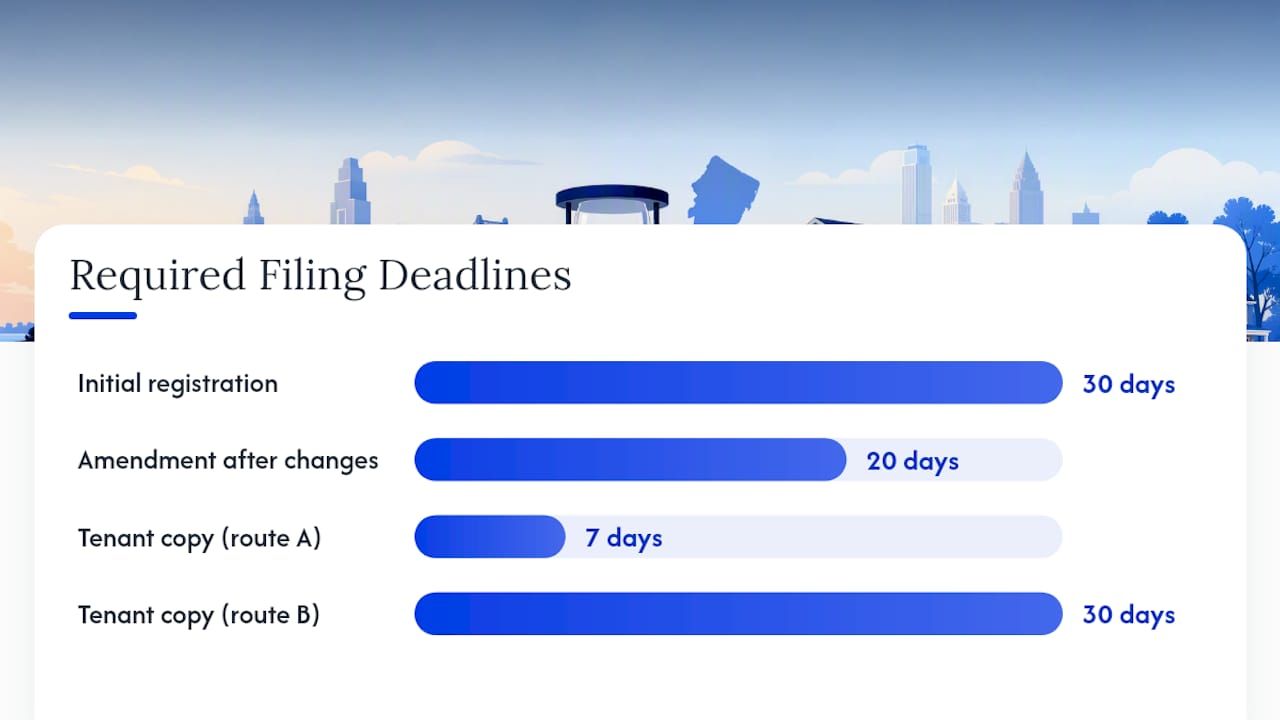
Registration isn’t a one-time task you file and forget. The statute requires an amended certificate within 20 days of any change in the information you originally filed, whether that’s a new managing agent, a change in mortgage holder, or a new emergency contact.
File on time. Initial registration is due within 30 days of purchase or at the creation of the first tenancy.
Amend within 20 days. Any change to owner, agent, or contact information triggers this window.
Deliver tenant copies promptly. Depending on your filing route, you owe tenants a copy within 7 or 30 days.
Log every delivery and update. Scan certificates, calendar your renewal dates, and check municipal websites periodically since ordinances change.
If you’re setting up a rental business for the first time, Business.NJ.gov’s landlord starter kit walks through registration alongside EIN setup and insurance basics.
Pro Tip: Set a recurring calendar reminder tied to your lease renewal date, not just the registration anniversary. Tenant turnover is when most landlords forget to re-file or update contact information.
How Does a Property Manager Handle Registration for You?
Handing registration off to a property manager doesn’t just save you paperwork time. It closes the gap between what the statute requires and what actually gets filed on schedule.
A manager typically handles:
Initial and amended filings with the municipal clerk or DCA
Coordinating lead paint inspections for pre-1978 buildings
Delivering and logging tenant copies of registration
Acting as the point of contact with municipal clerks when questions come up
You’ll still need to provide ownership documents, mortgage details, and emergency contact preferences upfront. In return, expect periodic compliance reports confirming your filings are current. Our New Jersey property management overview covers how this coordination works in practice.
Why Registration Deserves Routine Attention, Not an Afterthought
Landlords tend to treat registration as a box to check once and forget. That’s backward. The system exists to give tenants and officials a working line to the person actually responsible for the property, and letting that information go stale is what turns a routine filing into a courtroom delay.
Treat every ownership change, agent swap, or tenant turnover as a trigger to check your registration status. It protects your eviction rights and your property’s value at the same time.
— Main
Let 2ndstreetpropertymanagement Handle Your Registration Filings
Chasing down municipal clerk forms, tracking 20-day amendment windows, and coordinating lead paint certifications takes real time away from running your properties. 2ndstreetpropertymanagement is built by investors who’ve handled these exact filings across Southern New Jersey and regional suburbs, and we fold registration compliance directly into our management process rather than treating it as a separate task you have to remember.
Our services cover the filings themselves: initial registration, amendment tracking when your contact information changes, lead inspection coordination for pre-1978 buildings, and tenant notice delivery with a documented paper trail. You provide the ownership and mortgage details once; we keep the filings current from there. If you’re weighing whether to file the next registration yourself or hand it to a team that already knows your municipality’s quirks, request a compliance review from 2ndstreetpropertymanagement and get a clear answer on where your property stands today.
Sources
Recommended
Comments