
What Is a Landlord: Roles, Rights, and Responsibilities


A landlord is the owner of real property who grants another person or entity the right to occupy that property in exchange for rent. Under U.S. law, a landlord can be an individual, a corporation, an LLC, or a property manager acting on the owner’s behalf. The relationship is governed by state contract and property law, even when no written lease exists.
Two duties sit at the core of every landlord’s legal obligations, regardless of what the lease says:
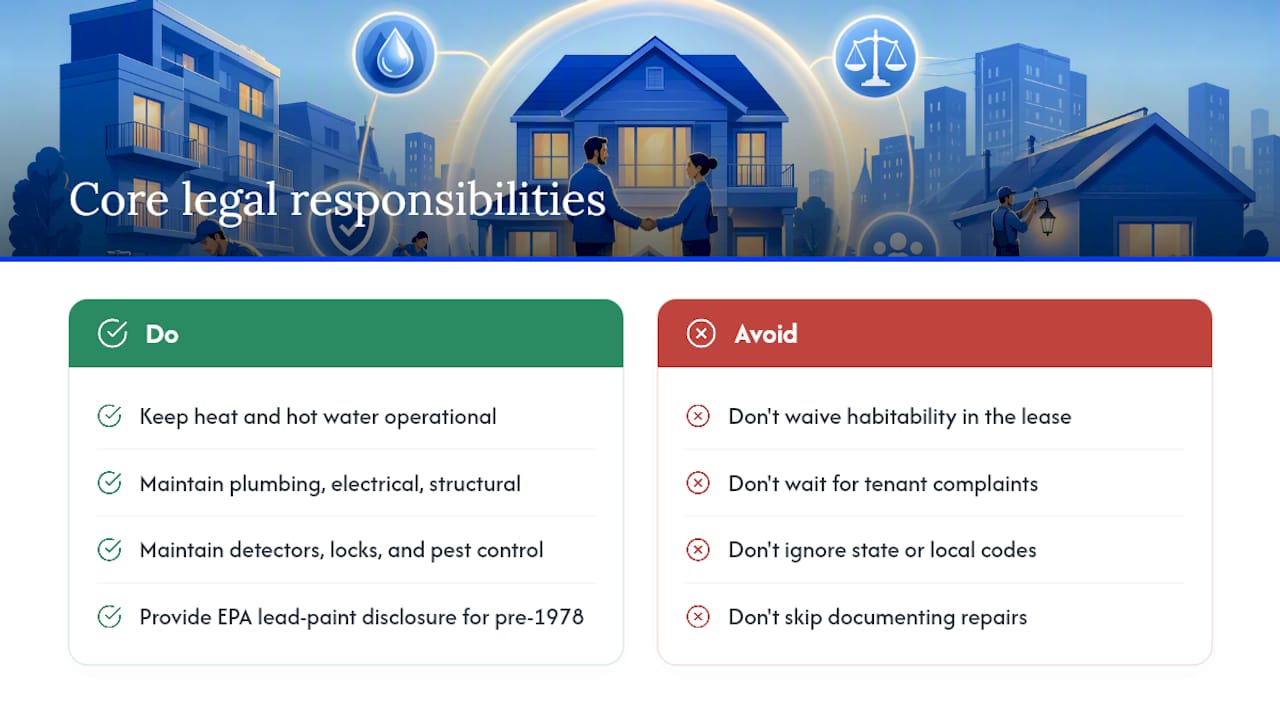
Warranty of habitability: Landlords must keep rental units safe, sanitary, and livable, covering functioning heat, plumbing, electricity, structural integrity, and basic security.
Disclosure and code compliance: Owners must follow federal disclosure rules (lead paint in pre-1978 housing) and meet state and local housing codes, including smoke and carbon monoxide detector requirements.
Table of Contents
What are a landlord’s core legal responsibilities?
The warranty of habitability is the single most important legal duty a landlord carries. Courts treat it as implied in every residential lease, and they regularly invalidate lease clauses that attempt to waive it. You cannot write your way out of this obligation with contract language.
In practice, that duty means keeping the following systems operational throughout the tenancy: heat and hot water, plumbing and sewage, electrical systems, structural components (roof, walls, floors), exterior doors and window locks, smoke and CO detectors, and pest control where infestations affect habitability. According to LII’s landlord-tenant law overview, tenants may have legal remedies when these standards are not met, including written repair demands, rent withholding in states that allow it, repair-and-deduct rights in others, or a rent credit ordered by a court.
Federal law adds one non-negotiable layer: owners of housing built before 1978 must provide tenants with an EPA-approved lead paint disclosure form before signing a lease. HUD enforces this requirement, and failure to comply carries civil penalties.
State and local codes layer on top of federal minimums. A landlord in New Jersey faces different notice periods and habitability standards than one in Texas. The NYC Bar’s practical guide frames these obligations as active duties, not passive ones. Waiting for a tenant to complain before addressing a known safety hazard creates liability exposure.
Statistic callout: Courts frequently invalidate lease provisions that attempt to waive the implied warranty of habitability, meaning the duty exists whether or not it appears in the lease.
Pro Tip: Document every repair request in writing. When a tenant reports an issue, respond by email or text, note the date, attach photos, and keep copies of all contractor invoices. A clear paper trail is your best protection if a dispute reaches court.
For a detailed breakdown of what habitability compliance looks like in practice, the 2026 habitability standards guide covers current requirements by system type.
What rights do landlords actually have?
Owning rental property comes with real legal authority, but each right has defined limits. Understanding both sides keeps you out of court.
Rent collection and fees. You have the right to collect rent on the agreed date, charge late fees when permitted by state law, and pursue unpaid balances through small claims court. Late fee caps and grace periods vary by state, so check your local statute before writing a fee policy into the lease.
Security deposits. Most states allow landlords to collect a security deposit, typically one to two months’ rent, to cover unpaid rent or damage beyond normal wear and tear. Return timelines after move-out range from 14 to 45 days depending on the state, and failure to return the deposit on time can result in penalties up to double or triple the deposit amount in some jurisdictions.
Right of entry. You retain ownership of the property, but a tenant holds exclusive possession during the lease term. That means you generally cannot enter without advance notice, typically 24 hours in most states, except in genuine emergencies such as a fire, flood, or gas leak. Repeated unannounced entries can constitute harassment and expose you to legal liability.
Eviction. When a tenant violates the lease or fails to pay rent, you have the right to begin the eviction process. The typical sequence looks like this:
Serve written notice (pay or quit, cure or quit, or unconditional quit, depending on the violation).
Wait the required notice period (3 to 30 days, state-dependent).
File an unlawful detainer or eviction complaint with the local court if the tenant does not comply.
Attend the court hearing; a judge issues a judgment for possession if you prevail.
Obtain a writ of possession and coordinate with the local sheriff for physical removal if needed.
Self-help evictions, changing locks, removing belongings, or shutting off utilities to force a tenant out, are illegal in every state and expose owners to significant damages.
State variation is real. California’s landlord-tenant guide illustrates how detailed state-level rules can be. Notice periods, allowable fees, just-cause eviction requirements, and deposit limits all differ by jurisdiction. Always confirm the rules for your specific state before acting.
How does a tenancy start, and what types exist?
The landlord-tenant relationship begins the moment an owner grants another person the right to occupy property in exchange for rent, whether that agreement is written, verbal, or implied by conduct.
Tenancy Type | Duration | Notice to End | Key Risk |
Fixed-term lease | Set end date (e.g., 12 months) | Usually none required at term end | Early termination penalties for both sides |
Month-to-month | Renews each month | 30 days (varies by state) | Less stability; easier to end |
Tenancy at will | No fixed term | Short notice or at-will | Unpredictable for both parties |
Verbal tenancy | Varies | State-dependent | Hard to enforce specific terms |
A verbal lease can still create a legally enforceable tenancy in most states. The risk is that neither side can prove the agreed terms if a dispute arises. Courts often default to state statutory minimums, which may not match what either party intended.
Every written lease should include these clauses at minimum:
Rent amount and due date
Late fee policy and grace period
Security deposit amount and return conditions
Maintenance responsibilities (who handles what)
Subletting policy
Utility responsibilities
Lease term and renewal conditions
Termination and early exit procedures
Missing even one of these creates ambiguity that tenants or courts can interpret against the owner.
When should a rental owner hire a property manager?
Self-managing one rental unit is manageable. Self-managing five units across two cities while working a full-time job is a liability waiting to happen. The decision to hire a property manager usually comes down to scale, geography, and how much legal complexity you are willing to carry personally.
Common triggers for hiring professional management:
You own more than two or three units and cannot respond to maintenance requests promptly.
Your rental is in a different city or state than where you live.
You have had a difficult eviction, a habitability complaint, or a fair housing issue.
Tenant turnover is high and leasing is consuming significant time.
You are not confident in your knowledge of local landlord-tenant law.
Typical fee structures in the U.S. include a monthly management fee (usually 8–12% of collected rent), a leasing fee for placing a new tenant (often one month’s rent or a percentage of it), and sometimes a maintenance coordination markup. A full breakdown of what these fees cover is available in the 2026 property management fee guide.
Before signing a management agreement, vet any candidate against this checklist:
Licensed in your state (required in most states)
Verifiable references from current clients
Clear scope of services: tenant screening, rent collection, maintenance coordination, eviction handling
Defined reporting cadence (monthly statements, maintenance logs)
Transparent fee schedule with no hidden markups
Understanding what a property management agreement covers before you sign protects you from surprises. Property management done well maximizes returns by reducing vacancy, minimizing legal exposure, and keeping maintenance costs predictable.
Key points every landlord and tenant should know
A landlord is the property owner who grants a tenant exclusive possession in exchange for rent, and that role carries non-waivable legal duties around habitability, safety, and fair dealing that exist regardless of what the lease says.
Point | Details |
Landlord definition | A landlord is the owner or legal lessor who grants a tenant the right to occupy property in exchange for rent. |
Warranty of habitability | Courts treat this as implied and non-waivable; landlords must maintain heat, plumbing, electricity, and structural safety. |
Eviction requires process | Self-help evictions are illegal; formal eviction requires written notice, a waiting period, and a court judgment. |
State law governs the details | Notice periods, deposit limits, and eviction timelines vary by state; always confirm local rules before acting. |
2ndstreetpropertymanagement | Owners in Southern New Jersey who want professional management can work with 2ndstreetpropertymanagement for tenant screening, rent collection, and compliance support. |
Tax implications and benefits for U.S. landlords
Rental income is taxable, but the IRS allows landlords to offset that income with a range of deductions that can significantly reduce the net tax burden.
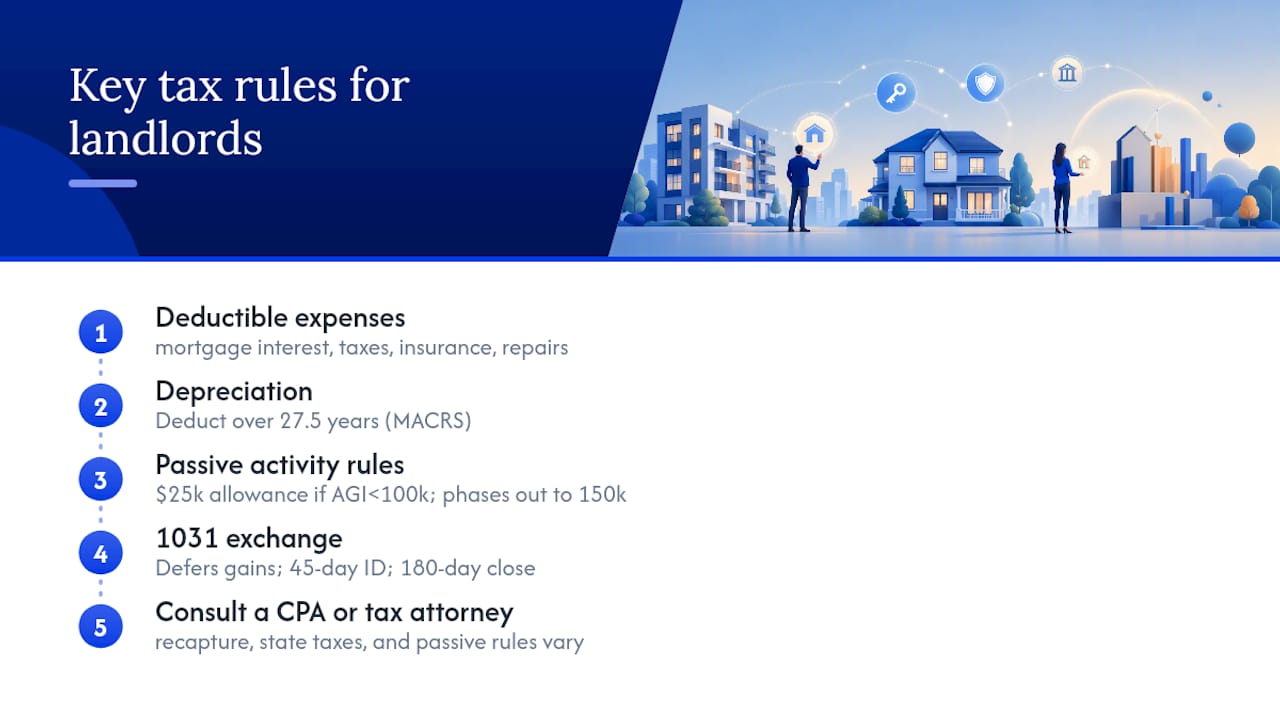
Deductible expenses include mortgage interest, property taxes, insurance premiums, repairs and maintenance, property management fees, advertising costs, legal and professional fees, and travel to the property for management purposes. These are ordinary and necessary business expenses under IRS rules.
Depreciation is the most powerful tax tool available to rental owners. Residential rental property is depreciated over 27.5 years under the Modified Accelerated Cost Recovery System (MACRS). This means you can deduct a portion of the property’s cost basis each year as a non-cash expense, reducing taxable income even in years when the property generates positive cash flow.
Passive activity rules apply to most landlords. Rental losses are generally considered passive and can only offset passive income, unless you qualify as a real estate professional under IRS rules or your adjusted gross income falls below $100,000, in which case up to $25,000 in rental losses may be deductible against ordinary income (this allowance phases out between $100,000 and $150,000 AGI).
A 1031 exchange allows owners to defer capital gains taxes when selling one investment property and reinvesting the proceeds into a like-kind property, provided strict IRS timelines are followed (45 days to identify a replacement, 180 days to close).
Consult a CPA or tax attorney familiar with real estate before filing, as depreciation recapture, state income taxes, and passive loss rules interact in ways that vary by individual situation.
What most landlords get wrong about their own role
The conventional framing of a landlord as someone who “collects rent and fixes things when asked” misses the actual risk profile of the job. The legal exposure runs in the other direction: courts hold landlords to an active standard of care, not a reactive one.
The warranty of habitability does not wait for a tenant complaint. If a landlord knows a heating system is aging and fails to address it before winter, that is not a maintenance delay. It is a foreseeable harm that courts have consistently treated as a breach of duty. The same logic applies to broken locks, exposed wiring, and pest infestations. Waiting for a written request before acting is a liability strategy that does not hold up.
The second thing owners underestimate is documentation. Most landlord-tenant disputes are not won on the merits of who was right. They are won by whoever has the cleaner paper trail. A landlord who can produce a signed lease, a move-in inspection report with photos, timestamped repair communications, and contractor invoices is in a fundamentally different legal position than one who cannot.
The third gap is state law. Owners who manage properties across multiple states, or who simply have not reviewed their state’s landlord-tenant statute recently, often operate on assumptions that no longer match current law. Notice periods change. Deposit rules tighten. Just-cause eviction requirements expand. The cost of staying current is low. The cost of getting it wrong is not.
Professional property management for Southern New Jersey owners
Owning rental property in Southern New Jersey means navigating state-specific habitability rules, tenant screening requirements, and eviction procedures that change more often than most owners realize. The operational load compounds quickly once you move past one or two units.
2ndstreetpropertymanagement handles the full operational scope for residential rental owners in Southern New Jersey: tenant screening, rent collection, maintenance coordination, lease enforcement, and eviction management. Built by investors for investors, the focus is on protecting your cash flow and keeping your properties compliant, not just occupied. Owners who work with 2ndstreetpropertymanagement get a dedicated management process designed around their portfolio, not a one-size-fits-all contract. If you own residential rentals in Southern New Jersey and want to stop managing the day-to-day yourself, request a consultation to see what professional management looks like for your specific properties.
Authoritative sources for landlord-tenant law
This article is general information, not legal advice. For contested disputes, consult a licensed attorney in your state. For habitability complaints, contact your local housing or code enforcement office.
Source | What It Covers |
Legal definition of landlord and overview of the landlord-tenant relationship under U.S. law | |
Habitability duties, essential systems, and tenant remedies | |
Non-waivable nature of the warranty and how courts treat lease waivers | |
Practical examples of landlord obligations and tenant remedies | |
Risk management, screening, and safety obligations for owners | |
State-level example of lease rules, notice periods, and tenant rights | |
Plain-language summary of operational responsibilities | |
Concise dictionary definition of landlord and lessor |
Recommended
Comments