
Serve NJ Rent Increase Notices: 5 Steps and a Copy Ready Sample


Under New Jersey law, a landlord who wants to enforce a higher rent must serve a valid written notice to quit and a separate notice of rent increase before that increase can be legally collected through eviction proceedings. There’s no single statewide percentage cap on rent increases in New Jersey. Increases simply cannot be “unconscionable,” and municipal rent-control ordinances can override that baseline entirely depending on where the property sits.
TL;DR:
Rent increases in New Jersey require separate written notices of rent hike and a valid notice to quit, served properly and documented carefully.
Local ordinances can impose stricter notice periods and caps, overriding the state’s unconscionability standard for units within municipal rent control areas.
Landlords must provide clear, formatted notices including tenant and property details, the current and new rent, effective date, and proof of service.
Courts favor landlords who justify substantial increases with objective cost drivers like comparable market rent or documented expenses.
Tenants should verify local rules, document notices, and seek legal advice if they suspect improper service or excessive increases.
Table of Contents
The Legal Foundation: Anti-Eviction Act and DCA Guidance
New Jersey’s Anti-Eviction Act, specifically N.J.S.A. 2A:18-61.1 and 2A:18-61.2, sets the framework landlords must follow to enforce a rent increase through eviction. Subsection f. of the statute requires a valid notice to quit paired with a separate notice of the rent increase itself. Skip either document, and a court won’t let you remove a tenant for refusing to pay the new amount.
The NJ DCA rent increase bulletin published in February 2008 remains the operative guidance on this process, and it spells out several requirements landlords routinely miss:
You cannot raise rent mid-lease without terminating the existing lease and offering a new one.
The notice must include a sample format the DCA provides, not just a verbal heads-up or a line item on a rent statement.
Security deposits tied to the increase have their own ceiling, which we cover below.
This is different from an ordinary nonpayment case, where NJ Courts guidance confirms landlords can often file without a pre-filing demand. Increase-based cases carry a stricter notice burden because the tenant hasn’t broken any existing agreement. They’re being asked to accept new terms.
How to Serve a Rent Increase Notice the Right Way
Timing depends heavily on tenancy type. A month-to-month tenant typically gets a 30-day baseline notice, but a tenant under a fixed-term lease can’t see a rent hike take effect until that lease actually expires. You can’t amend the numbers halfway through a signed term.
Follow this sequence to keep the process defensible:
Confirm the tenancy type — check whether the lease has expired, is month-to-month, or still has time remaining.
Check municipal rules first — some towns require longer notice periods or additional forms before you draft anything.
Draft both documents — the notice to quit and the notice of rent increase, using the DCA’s sample structure.
Serve properly — personal delivery or certified mail with return receipt are your safest options.
Keep every record — signed receipts, certified mail tracking numbers, and dated copies of what was sent.
Pro Tip: Never rely on a text message or a verbal conversation as your only proof of notice. If a dispute reaches a rent-control board or a courtroom, the landlord with a certified mail receipt wins the argument before anyone even discusses the rent amount.
Sample Notice Language and What Every Notice Must Include
A compliant notice doesn’t need to be complicated, but it does need specific fields. Leave one out and you risk having the whole notice thrown out.
Every notice to quit paired with a rent increase should include:
The tenant’s name and the property address
Current rent amount and the new proposed rent
The effective date of the increase
A clear statement that the current lease is being terminated
An offer to renew at the new rate, with a deadline to respond
The landlord’s signature and the date of service
Proof of how and when the notice was delivered
Here’s how the security deposit rule works alongside a rent increase, straight from the DCA bulletin:
Item | Rule |
Rent increase cap | No statewide numeric limit; must not be unconscionable |
Security deposit cap | Cannot exceed 1.5 times monthly rent |
Deposit increase timing | May be raised alongside a rent increase, within that 1.5x ceiling |
Notice requirement | Notice to quit plus separate notice of increase, per DCA bulletin |
Our guide to legally valid rent increase notices walks through additional formatting details if you want a deeper template.
When a Rent Increase Crosses the Line Into Unconscionable
New Jersey courts decide unconscionability case by case, since no statute defines it with a number. That’s frustrating if you want a bright-line rule, but it also means a well-documented landlord has real room to justify a substantial increase.
Judges tend to side with landlords who can point to objective cost drivers rather than a number pulled from nowhere. Defensible reasons include:
Market comparables showing similar units renting at or above the new price
Documented increases in property taxes or insurance premiums
Capital improvements like a new roof, HVAC system, or major renovation
Reasons that draw scrutiny include retaliation against a tenant who filed a complaint, or an arbitrary spike with no relationship to actual costs.
Pro Tip: Screenshot your market comps the same week you draft the notice, with the date visible. A comp pulled six months later, after a dispute has already started, looks manufactured to a judge even if the numbers are accurate.
Checking for Municipal Rent Control Before You Raise the Rent
Some New Jersey cities cap rent increases through local ordinance, and those rules override the state’s general “not unconscionable” baseline for any unit they cover. Newark, for example, maintains a dedicated rent control page outlining local limits and filing procedures that apply to qualifying units within city limits.
Before you send any notice, verify local coverage through these channels:
Your municipal clerk’s office, which can confirm whether your unit falls under a local ordinance
The rent control board’s website, if your municipality maintains one
The DCA’s Truth in Renting guide, which explains how to confirm applicability
Our overview of NJ rental registration requirements, since registration and rent control checks often overlap
If an ordinance does apply, follow its specific notice period, its cap or CPI-based formula, and its frequency limits. Document that compliance the same way you’d document unconscionability evidence.
What Tenants Should Do After Receiving a Rent Increase Notice
Getting a rent increase notice doesn’t mean you have to accept it silently or move out immediately. Take these steps in order:
Read the notice carefully and save a copy, along with the envelope or certified mail slip it arrived in.
Check your lease and your municipality’s rules to see whether a local cap or CPI formula should have limited the increase.
Contact a tenant helpline or legal aid office if the amount seems disproportionate or the notice looks improperly served.
File a complaint with your local rent control board, if one exists and covers your unit.
Raise unconscionability or improper notice as a defense if the landlord pursues eviction over the increase.
Under NJ Courts guidance, tenants facing eviction over an increase-based nonpayment claim can generally stop the process by paying the amount due before a final judgment is entered, similar to standard pay-to-stay protections. Subsidized housing tenants should double-check their program’s specific rules, since HUD and NJHMFA-regulated projects sometimes follow separate procedures.
How a Property Manager Handles a Rent Increase From Start to Finish
We treat every rent increase as a three-part project: legal check, communication, and documentation. First, we verify municipal rules and confirm the lease’s actual expiration or notice window. Then we draft the notice to quit and the notice of increase together, serve them with proof, and offer the tenant clear new-lease paperwork.
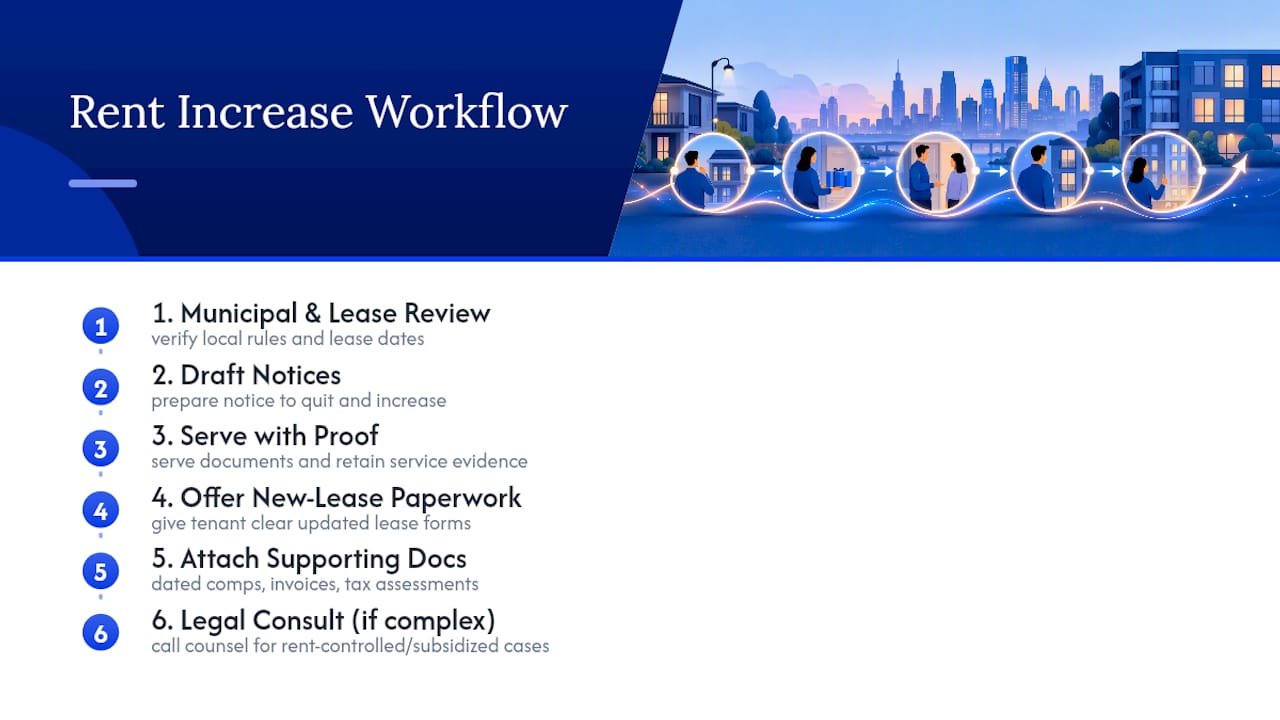
Every file gets backed with dated market comps, contractor invoices, and tax assessment notices, so if a dispute ever surfaces, the paper trail already exists.
Pro Tip: Complex situations, like large increases on rent-controlled units or subsidized housing, deserve a call to legal counsel before you send anything. A five-minute consult is cheaper than a dismissed eviction case.
The Mistakes That Turn a Simple Increase Into a Legal Mess
Most disputes we see trace back to three errors: assuming no local ordinance applies without checking, raising rent with no documented reason behind the number, and serving notice with no real proof it arrived. None of these mistakes are complicated to avoid. They just require treating notice as a process, not paperwork you rush through. Large or contested increases still deserve a lawyer’s eyes before you send anything.
— Main
Let 2ndstreetpropertymanagement Handle Your Rent Increase Notices
Getting a rent increase notice right in New Jersey means tracking municipal ordinances, statutory notice requirements, and airtight documentation, all before you send a single letter. 2ndstreetpropertymanagement is the alternative to handling this alone: we draft and serve compliant notices, run the municipal compliance check for you, and keep every receipt, comp, and invoice organized in case a dispute ever comes up.
That means less time spent second-guessing statute language and far less exposure if a tenant challenges the increase later. Our team also handles lease administration and recordkeeping year-round, not just at renewal time, so your file stays defensible whether it’s month three or month thirty. If you own rental property in Southern New Jersey and want this process handled correctly the first time, reach out through our New Jersey property management page to schedule a consultation.
Where to Verify These Rules Yourself
NJ DCA Landlord/Tenant Information covers the statewide framework and confirms there’s no numeric rent cap.
NJ Courts Landlord-Tenant guidance explains eviction procedure and pay-to-stay timelines.
N.J. Admin. Code § 5:24-2.8 addresses rent increases for certain regulated housing projects.
Newark’s rent control page shows what a municipal ordinance page looks like in practice.
Sources
Recommended

Comments