
NJ Landlords: Eviction Notice Compliance, Sample Language, Checklist


In New Jersey, landlords primarily use two instruments: a Notice to Cease when the tenant’s behavior can still be corrected, and a Notice to Quit when the tenancy must formally end. Nonpayment of rent typically requires no pre-filing notice, but most other grounds carry a statutory waiting period under the Anti-Eviction Act. Skipping required steps or filing prematurely can cause dismissal. Only a court can order removal.
TL;DR:
Serving the correct notice type and timing is critical; serving a Notice to Cease or Notice to Quit improperly can result in case dismissal.
Nonpayment of rent usually requires no pre-filing notice unless federal or state subsidies are involved, which may demand 14 or 30 days’ notice.
Statutory notice periods vary from three days to three years depending on the eviction ground, and filing too early will lead to dismissal.
Proper documentation of notices, service method, and attempts is essential to avoid case dismissals based on process errors.
Long notice grounds like retirement or condo conversion often require additional steps such as relocation assistance and DCA notification, requiring careful project planning.
Table of Contents
Understanding Eviction Notice Types in NJ
New Jersey gives landlords two main tools, and picking the wrong one (or serving it in the wrong order) is the single fastest way to lose a case you should have won.
A Notice to Cease functions as a warning shot. It tells a tenant to stop specific behavior. Disorderly conduct, unauthorized pets, unapproved subletting, and habitual late payment all typically require one. There is no fixed statutory countdown for a Notice to Cease. Courts instead judge whether you gave the tenant a “reasonable” chance to fix the problem before moving forward, according to NJ Courts self-help guidance. That flexibility cuts both ways: it protects landlords from an arbitrary deadline, but it also means a judge can decide your two-day cure window wasn’t reasonable.
A Notice to Quit is the formal termination notice. It ends the tenancy and starts the statutory waiting period tied to your specific ground. Once that period expires, you can file the eviction complaint in Landlord-Tenant Court.
Nonpayment of rent sits outside both categories; in most cases, you can file directly with the court once rent is late, without serving any notice first, based on the DCA’s Grounds for Eviction Bulletin. The exceptions matter:
Federally backed mortgages or HUD-subsidized units can require 14 or 30 days’ notice before a nonpayment filing.
Habitual late payment (as opposed to a single missed month) generally needs a Notice to Cease first, since it’s treated as a pattern-of-conduct issue rather than simple nonpayment.
Lease clauses sometimes impose grace periods that function as de facto notice requirements even when the statute doesn’t demand one.
Statutory Notice Periods by Eviction Ground
New Jersey doesn’t leave notice periods to negotiation. N.J.S.A. 2A:18-61.2 sets a specific waiting period for each eviction ground, and filing even one day short gets the case thrown out.
Here’s how the periods break down against the most common grounds landlords encounter:
No notice required: Nonpayment of rent (outside federally covered exceptions)
Three days: Disorderly conduct that destroys the peace, or willful/grossly negligent damage to the property
One month: Habitual late payment, lease violations, disorderly conduct, or refusal to accept reasonable lease changes
Two months: Owner seeking personal occupancy in a building of three units or fewer
Three months: Removal for health or safety reasons following code violations
Eighteen months: Permanent retirement of the property from residential rental use
Three years: Conversion of the building to a condominium or cooperative
Notice periods are not suggestions. They’re jurisdictional facts a judge checks before hearing anything else about your case. File a nonpayment complaint the day after rent is late and you’re fine. File a “personal occupancy” complaint on day 58 of a required 60-day notice, and the court dismisses it regardless of how strong your underlying case is.
The long-notice grounds deserve special attention. Permanent retirement and condo conversion don’t just require patience. They typically trigger relocation-assistance obligations and, in many municipalities, a requirement to notify the DCA before proceeding. Plan those cases like a project with a timeline, not a single filing event.
Drafting and Serving a Legally Sufficient Notice
A notice that’s vague, misdated, or improperly served is worse than no notice at all, because it burns your waiting period without giving you a valid case. Follow these steps in order:
State the specific ground with facts, not labels. “Nonpayment” or “lease violation” alone won’t survive scrutiny. Include dates, amounts, and the exact lease clause violated.
Calculate the vacate date from the statutory period, not a guess. Count forward from the date of service, not the date you signed the notice.
Identify the tenant by full legal name as it appears on the lease, along with the property address including unit number.
Choose your service method deliberately. Personal service is strongest. Service to a household member age 14 or older is acceptable. Certified mail, return receipt requested, is the fallback that creates a paper trail if the tenant refuses direct contact, per LegalClarity’s service breakdown.
Document every attempt. Keep certified mail receipts, signed affidavits of personal service, and dated photos if you post a notice on the door as a last resort.
Confirm whether a Notice to Cease must precede your Notice to Quit. Behavior-based grounds almost always need one; nonpayment almost never does.
Pro Tip: Keep a single file per unit with every notice, receipt, and photo timestamped in order. When you’re standing in front of a judge eight weeks from now, that file is the difference between a five-minute hearing and a case getting kicked for lack of proof.
Before filing, gather your lease, proof of municipal rental registration, a written statement of the case, and proof of every notice served. Courts expect all of it on the first appearance.
Why Eviction Cases Get Dismissed
Most dismissed eviction cases in New Jersey aren’t lost on the merits. They’re lost on process.
Filing before the waiting period fully runs. Even one day early gets the complaint dismissed, forcing you to re-serve and restart the clock.
Vague notices. “You violated your lease” doesn’t cut it. Cite the clause, the date, and the specific conduct.
Skipping the Notice to Cease when the ground requires one, or serving it by a method the statute doesn’t recognize.
Overlooking federal coverage. A federally backed mortgage or subsidy program can extend your required notice period well past what state law demands, and courts don’t excuse landlords who didn’t check.
Missing DCA notification or relocation assistance on long-notice grounds like retirement or conversion, which can stall or void the entire proceeding.
Treating repeated late-payment acceptance as neutral. If you accept late rent for months after issuing a Notice to Cease, courts can treat that notice as waived, according to DCA guidance on habitual late payment. You need a fresh warning that acknowledges the pattern continued.
Templates and a Pre-Filing Checklist That Actually Prevent Dismissals
Templates only help if they’re built around the exact statutory language courts expect to see. When rent increase is your asserted ground, for example, the notice of increase and the Notice to Quit need to work together. Our step-by-step rent increase notice guide includes copy-ready sample language landlords can adapt, since serving the increase notice without a properly timed Notice to Quit leaves the tenancy running at the old rent.
Before filing anything, run through this checklist:
Confirm municipal rental registration is current and you have proof in hand.
Verify the correct notice type was served for your specific ground.
Confirm service method and retain proof (affidavit, certified mail receipt, or both).
Calculate the vacate date against the statutory period, then add a buffer day.
Check for federal mortgage or subsidy coverage that could extend your timeline.
If any checklist item comes back uncertain, particularly federal coverage or a contested Notice to Cease, that’s the point to bring in counsel or contact the DCA before spending money on a filing fee.
How Tenants Typically Respond to Notices
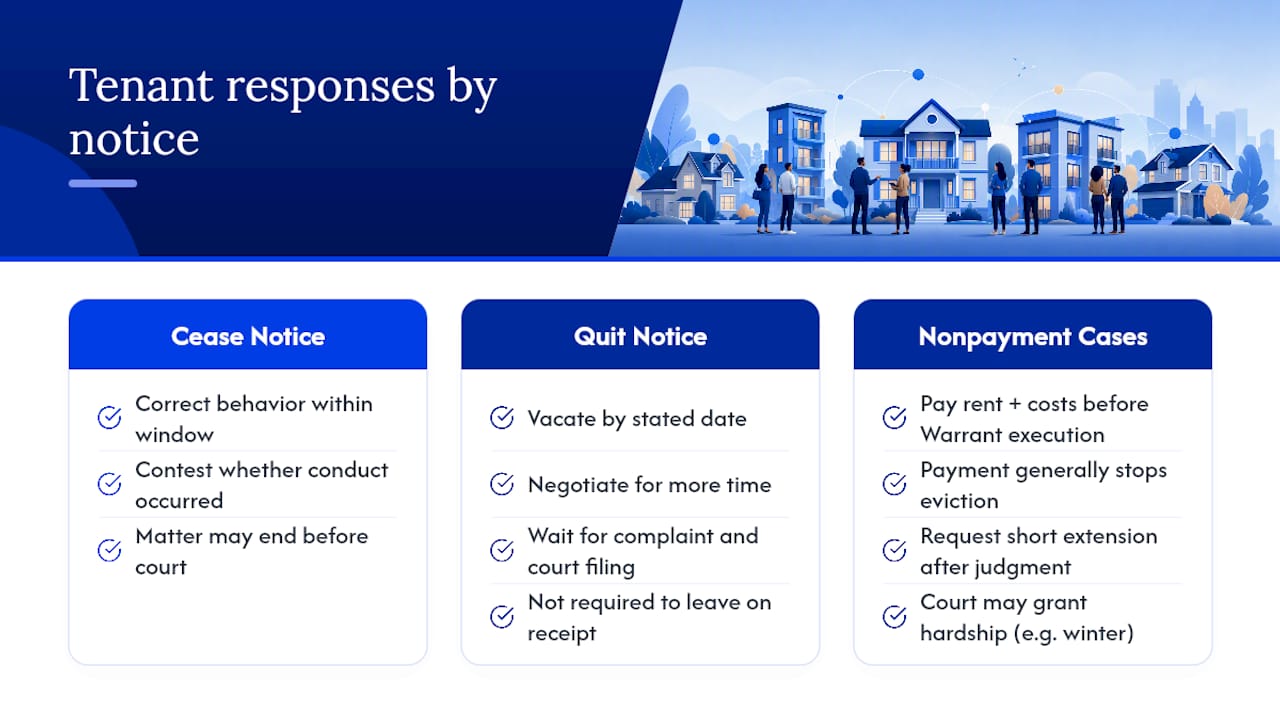
Tenants who receive a Notice to Cease often respond by correcting the behavior within the window they believe is reasonable, which can end the matter before it reaches court. Some contest whether the conduct described actually occurred, setting up a factual dispute a judge will need to resolve.
With a Notice to Quit, the tenant’s options narrow. They can vacate by the stated date, negotiate directly with you for more time, or wait for you to file and respond once served with the actual court complaint. A tenant is never required to leave simply because they received a Notice to Quit. The notice starts your right to file, not an automatic obligation for them to move.
For nonpayment cases, many tenants pay the outstanding balance before the court date. In New Jersey, paying rent owed plus court costs at any point up to the actual execution of the Warrant of Removal generally stops the eviction, which is why “pay to stay” resolves a large share of nonpayment filings before they reach a lockout. Tenants can also request a short extension from the court after judgment, particularly during winter months or with documented hardship. Landlords who understand this timeline tend to negotiate more effectively than those who assume a judgment ends the conversation.
Legal Defenses Tenants Commonly Raise in NJ Court
Tenants and their attorneys have a standard playbook of defenses, and understanding them helps you avoid handing one over for free.
The most common defense is improper notice, either the wrong type served, insufficient factual detail, or a waiting period that hadn’t fully run. Because New Jersey courts enforce these requirements strictly, a technical defect here can end your case regardless of how legitimate your underlying ground is.
Improper service is a close second. If you can’t produce an affidavit or certified mail receipt proving the tenant actually received the notice, the defense often wins. Habitability defenses come up frequently in nonpayment cases: tenants argue that unrepaired conditions justified withholding rent, shifting the fight from “did you pay” to “did the unit meet code.” Some tenants raise retaliation or discrimination claims, alleging the notice followed a complaint to code enforcement or a protected-class issue. Courts take these seriously enough to delay proceedings while they’re investigated.
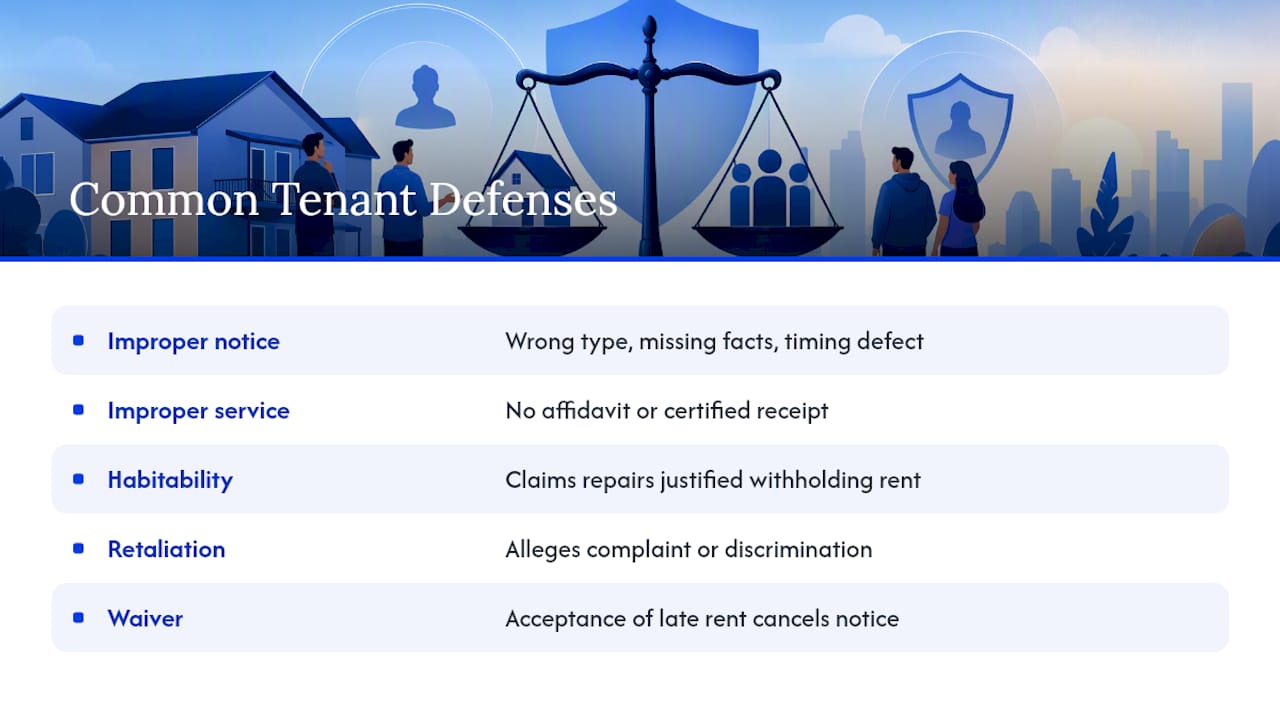
Finally, tenants sometimes argue waiver, claiming that your acceptance of late rent after a Notice to Cease effectively canceled that notice, which ties directly back to the habitual late payment trap covered earlier.
Where Tenants Facing Eviction Can Get Help
Landlords benefit from knowing what resources are available to tenants, both because it shapes how a case unfolds and because informed tenants tend to resolve matters faster.
New Jersey Legal Services and Legal Aid organizations provide free representation to income-qualifying tenants in eviction cases, and many courts now have on-site legal help desks specifically for landlord-tenant matters. Court-connected mediation programs exist in most New Jersey counties, giving both sides a chance to negotiate payment plans or move-out timelines before a judge issues a ruling. The NJ Courts self-help center publishes plain-language guides covering the entire process from notice through warrant execution, and it’s a resource worth pointing tenants toward directly if a dispute looks headed for a drawn-out fight. Tenants facing emergency situations can also contact county welfare agencies for rental assistance funds, which sometimes resolve nonpayment cases faster than litigation would.
When to Litigate vs. When to Negotiate
Immediate nonpayment filings make sense when the balance is significant, the tenant has gone unresponsive, or you’ve already seen a pattern of broken promises. Filing fast preserves your legal position without closing the door to settlement later.
Negotiation, often structured as pay-to-stay, tends to protect value better when the tenant has a stable payment history and the shortfall traces to a one-time hardship. Court costs, turnover expense, and vacancy loss usually outweigh what you’d gain from pushing a fixable situation into litigation.
Whichever path you choose, document it. Every notice, every payment plan, every text message about a promised payment date belongs in the file. That habit protects you and the property owner if the case does end up in front of a judge months later.
— Main
How 2ndstreetpropertymanagement Handles Notices and Filings
Getting a notice wrong costs you the waiting period you just spent weeks running. Professional property management services handle notice drafting, service documentation, and court-filing support to assist New Jersey investor landlords with eviction processes.

Our team drafts fact-specific Notices to Cease and Notices to Quit tied to the exact statutory ground, coordinates certified mail or personal service and keeps the receipts and affidavits you’ll need in court, and helps arrange relocation assistance when a long-notice ground like retirement or conversion applies. We also flag federally backed mortgage or subsidy coverage before you file, which is where a surprising number of otherwise solid cases fall apart. If you manage rental property in Southern New Jersey and want a compliance review before your next filing, visit 2ndstreetpropertymanagement’s property management page to request a sample notice or start a conversation about ongoing management.
Statutes and Government Guidance Worth Bookmarking
Before filing anything, verify the details against the primary sources. The New Jersey Eviction Law, N.J.S.A. 2A:18-53 through 2A:18-84, governs every notice period cited here. The DCA’s Landlord-Tenant Process Guide walks through what happens after a Judgment for Possession, including warrant scheduling and tenant last-chance options.
This article is general information, not a substitute for advice from a qualified lawyer. Consult a qualified legal professional about your own circumstances before acting on anything here.
Sources
FAQ
What’s the difference between a Notice to Cease and a Notice to Quit in NJ?
A Notice to Cease warns a tenant to stop specific behavior, like a lease violation or disorderly conduct, and gives them a reasonable chance to correct it. A Notice to Quit formally ends the tenancy and starts the statutory waiting period before you can file in court, as outlined by NJ Courts.
Do I need to serve a notice for nonpayment of rent in NJ?
In most cases, no. New Jersey lets landlords file for nonpayment directly with the court without a pre-filing notice, though federally backed mortgages or subsidized units can require 14 or 30 days’ notice instead, according to LegalClarity’s breakdown of NJ notice rules.
How long is the notice period for a lease violation in NJ?
Most lease violations and habitual late payment situations require a one-month Notice to Quit under N.J.S.A. 2A:18-61.2. Serious conduct that destroys the peace or causes willful property damage drops to a three-day notice period instead.
Can a landlord evict a tenant without going to court in New Jersey?
No. New Jersey law requires a court-ordered Judgment for Possession and a Warrant of Removal before any tenant can be forced out, and self-eviction tactics like lockouts or shutting off utilities are illegal regardless of the notice served, per NJ Courts self-help guidance.
Does 2ndstreetpropertymanagement help landlords draft eviction notices?
Yes. 2ndstreetpropertymanagement drafts fact-specific Notices to Cease and Notices to Quit, coordinates proper service and documentation, and supports court filings for investor landlords in New Jersey. Current pricing details are available directly on the 2ndstreetpropertymanagement site.
Recommended
Comments