
What Is a Rent Escrow: A Tenant's Guide

Rent escrow is a court-directed process that lets you pay rent into a neutral, court-controlled account instead of directly to your landlord when serious habitability problems remain unrepaired after proper notice. LegalClarity explains that redirecting payment to the court, rather than stopping payment altogether, is what shields you from eviction while your case proceeds. If your unit has a genuine life, health, or safety threat and your landlord has ignored written notice, rent escrow may be the legal lever you need.
Before you file anything, take these three steps right now:
Document the problem. Take dated photos and videos of every defect. Note dates, times, and any symptoms (illness, cold temperatures, water damage).
Send written notice to your landlord. Use certified mail with return receipt so you have proof of delivery and the date the landlord received it.
Contact your local court clerk or legal-aid organization. Ask specifically about rent escrow filing procedures, required forms, and acceptable payment formats in your jurisdiction.
Pro Tip: Keep paying your full rent on time, but once the court approves your escrow filing, deposit it into the court account, not to your landlord. Stopping payments without court approval is the fastest way to face an eviction notice.
Table of Contents
When does a problem qualify for rent escrow?
Not every repair dispute qualifies. Courts look for conditions that present a substantial threat to life, health, or safety, not cosmetic issues or minor inconveniences. Maryland Legal Aid’s rent escrow brochure lists the kinds of conditions that typically meet this threshold:
No heat during cold months
No running water or hot water
Sewage backups or raw sewage exposure
Exposed or faulty electrical wiring and fire hazards
Severe mold or pest infestations affecting health
Structural defects (collapsing ceilings, failing floors)
Lead paint hazards, especially where children live
Minor issues, like a slow-draining sink or a broken cabinet hinge, rarely qualify. Courts also commonly reject cases where the tenant caused the damage, refused to allow the landlord reasonable access to make repairs, or where the specific dispute type falls outside the local escrow statute. Ohio’s landlord-tenant statute is one example of how state law defines habitability duties and the conditions that trigger remedies.
What qualifies in one state may not qualify in another. Some cities and counties layer additional rules on top of state law. Always verify the specific threshold in your jurisdiction before filing.
How does rent escrow work, step by step?
Follow this sequence carefully. Procedural errors, like skipping written notice or depositing rent in the wrong format, can get your case dismissed before a judge ever hears the substance of your complaint. The Maryland Judiciary’s rent escrow guidance outlines a process that mirrors what most U.S. courts require.
Confirm rent escrow is available in your jurisdiction. Look up your state’s landlord-tenant statute or call your local court clerk. Minnesota’s statute 504B.385 is a clear example of how states codify the rent-escrow remedy in statutory text.
Pro Tip: Start a rent ledger the day you file. Log every deposit date, amount, and receipt number. Judges notice disciplined payment behavior, and a clean ledger signals that you are acting in good faith, not trying to avoid rent.
How to prepare your case: evidence and the hearing packet
A well-organized hearing packet can be the difference between a judge ordering repairs and a judge dismissing your case. People’s Law Center’s rent escrow guide emphasizes that clear, dated evidence is what moves courts to act. Gather these items before you file:
Dated photos and videos of every defect, labeled by room and date
Copies of all written notices you sent, with certified-mail receipts
Screenshots of text messages or emails with your landlord about the problem
A maintenance log showing dates you reported the issue verbally or in writing
Medical notes or doctor’s letters if the condition affected your health
Contact information for any witnesses (neighbors, guests who observed the problem)
Prior code-enforcement complaints and any inspector’s written findings
Getting a housing or building inspector involved strengthens your case significantly. Contact your city or county code-enforcement office and request an inspection. An inspector’s written report carries authority a judge respects, and in some jurisdictions the inspector’s deadline for landlord compliance is shorter than the standard 30-day window courts apply.
Organize your packet with a cover sheet that lists your name, address, case number, and a brief timeline. Place photographs in chronological order, each labeled with the date and what it shows. Attach copies of receipts and any prior code-enforcement complaints behind the photos. A concise one-page summary statement, written in plain language, helps the judge follow your argument quickly.
When you go to file, bring the exact rent amount in an acceptable instrument. Call the clerk’s office the day before to confirm their hours, the form names they use, and whether they require one copy or multiple copies of your petition.
A note on inspector reports: Municipal code-enforcement offices and health departments publish their inspection procedures online. An inspector’s report filed before your hearing date is among the most persuasive documents you can bring.
What can the court order, and where does the money go?
Once the hearing concludes, the judge has several options. Investopedia’s rent escrow explainer explains that the court holds all deposited funds in trust and decides distribution based on the evidence presented and whether repairs were completed.
Scenario | Likely court outcome |
Landlord completes repairs before or by the hearing | Escrowed funds released to the landlord |
Repairs not done; court authorizes repair funding | Funds paid to a contractor from escrow |
Partial repairs; tenant suffered losses | Funds split between landlord and tenant |
Serious ongoing violations; lease unworkable | Early lease termination ordered |
Tenant caused damage or blocked access | Case dismissed; funds released to landlord |
The court may also order a rent reduction going forward, require the landlord to complete repairs by a specific deadline, or schedule a follow-up hearing to verify compliance. Some courts allow inspection fees or repair-verification costs to be deducted from escrowed funds.
Missing escrow deposits after filing is one of the most common reasons cases collapse. Courts treat a lapse in deposits as evidence that the tenant is simply avoiding rent, not pursuing a legitimate habitability remedy. Keep depositing on every due date until the judge says otherwise.
What are the risks of rent escrow, and what are the alternatives?
Rent escrow is a powerful remedy, but it carries real procedural risk. Go in with clear eyes.
Primary risks:
Eviction exposure. If you fail to follow the court-approved process, miss deposits, or the judge finds you caused the damage, you can face eviction for nonpayment.
Case dismissal. Blocking landlord access to make repairs is a common reason courts dismiss tenant petitions.
Costs. Court filing fees, inspection fees, and potentially attorney fees add up. Some courts may order the tenant to pay for repairs if the landlord is found to have acted reasonably.
Burden of proof. You must show the condition is serious, that you gave proper notice, and that the landlord had a reasonable opportunity to fix it.
Alternatives worth considering:
Code enforcement complaint: Filing with your city or county housing inspector costs nothing and can produce an official violation notice that pressures the landlord without court involvement.
Repair-and-deduct: Some states allow tenants to hire a contractor and deduct the cost from rent, but this remedy has strict dollar caps and procedural requirements. Check your state statute before using it.
Small-claims negotiation: For lower-cost disputes, a small-claims filing or a direct written demand with a repair deadline can sometimes resolve the issue faster than escrow.
Rent withholding: A handful of states permit outright rent withholding under specific conditions, but this is narrower than escrow and carries higher eviction risk.
Rent escrow makes the most sense when the problem is urgent, code enforcement or direct negotiation has failed, and you can reliably follow the procedural requirements. If you are unsure whether your situation qualifies, consult a legal-aid attorney before filing. The Akron Municipal Court’s rent escrow page is a good example of the kind of local court guidance that can help you decide.
How do rent escrow laws vary by state, and where do you find the forms?
There is no single federal rent escrow law. Every state, and sometimes every city, sets its own rules for notice periods, qualifying conditions, filing procedures, and acceptable payment formats. What works in Maryland will not necessarily work in Texas or California.
Here is where to look for the rules that apply to you:
Your state’s legislature or revisor website. Search for “[your state] landlord tenant statute” or “[your state] rent escrow.” Minnesota’s 504B.385 is a clean example of what statutory text looks like.
Your local district or county court clerk’s website. Many courts publish the exact form names, filing fees, and payment requirements online. The Maryland Courts Court Help Center is a model of what a well-resourced court help page looks like.
Municipal code-enforcement offices — These offices can tell you what local housing codes apply and how to request an inspection.
Call the clerk’s office before you travel to file. Confirm the form name, the number of copies required, acceptable payment instruments, and the clerk’s hours. Showing up with the wrong payment format or an outdated form can cost you a filing deadline.
Key Takeaways
Rent escrow works only when you redirect full rent payments to the court on time, every time, while building a documented case that the habitability problem is serious and the landlord had fair notice to fix it.
Point | Details |
Redirect, don’t stop | Pay full rent into the court account on every due date to avoid eviction exposure. |
Qualify the condition first | Only life, health, or safety threats typically meet the escrow threshold; check your state statute. |
Written notice is mandatory | Send notice by certified mail with return receipt before filing; no proof of notice, no case. |
Organize your hearing packet | Bring dated photos, inspection reports, certified-mail receipts, and a rent ledger to court. |
Laws vary by jurisdiction | Confirm form names, payment formats, and notice periods with your local court clerk before filing. |
Rent escrow is a tool, not a shortcut
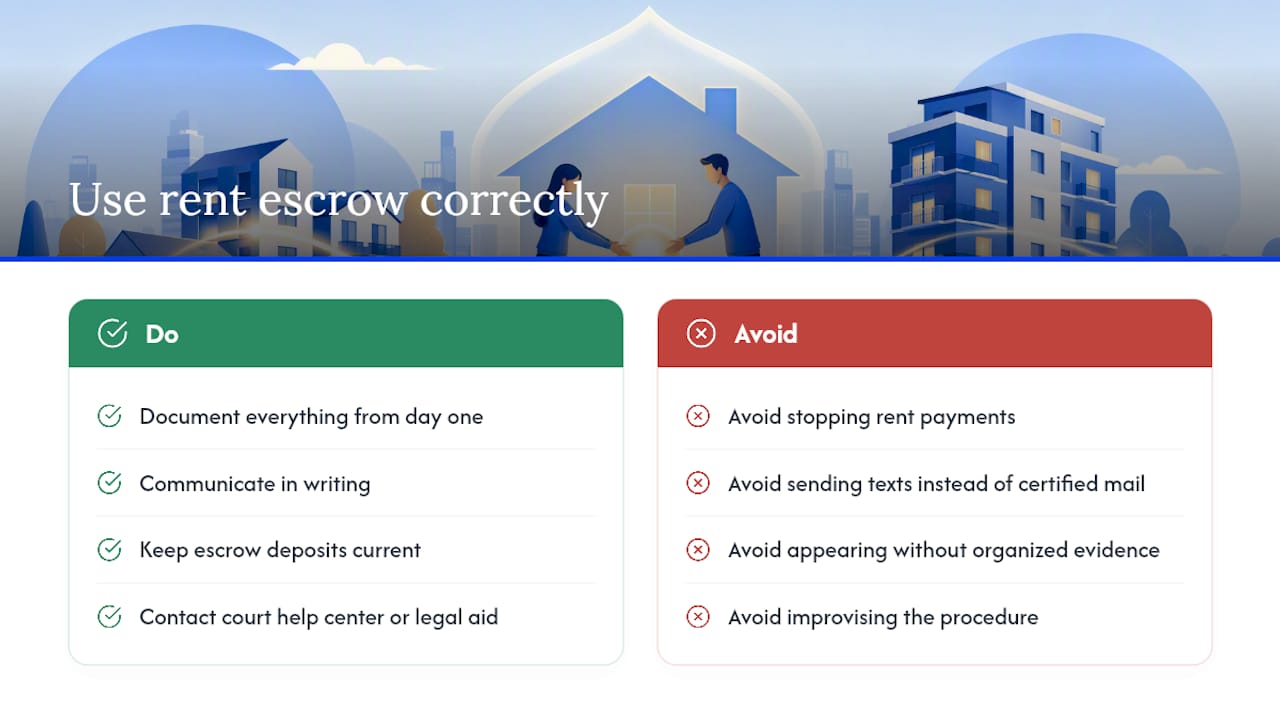
Most tenants who struggle with rent escrow cases do so not because their habitability problem was too minor, but because they treated the process as informal. They stopped paying rent instead of redirecting it. They sent a text message instead of certified mail. They showed up to the hearing without organized evidence. The legal mechanism is genuinely protective when you use it correctly, and genuinely dangerous when you improvise.
From a property-management perspective, the tenants who get the fastest results are the ones who document everything from day one, communicate in writing, and keep their escrow deposits current without exception. Judges notice. A clean deposit record tells the court you are a tenant pursuing a legitimate remedy, not someone looking for a free month’s rent.
If you are facing a serious habitability problem right now, the most important thing you can do today is contact your local court help center or a legal-aid organization. They can confirm whether rent escrow applies in your jurisdiction, give you the correct forms, and help you avoid the procedural mistakes that sink otherwise valid cases. You have real legal tools available. Use them carefully, and they work.
Where to find forms, statutes, and free help
These are the most reliable places to get accurate, jurisdiction-specific information before you file:
State legislature or revisor websites. Search your state name plus “landlord tenant statute” or “rent escrow.” Minnesota’s 504B.385 and Ohio’s landlord responsibilities code are examples of what to look for.
Local district or county court clerk pages. Many publish form names, filing fees, and payment requirements. The Maryland Courts Court Help Center offers free procedural guidance and clerk contact information.
Legal-aid organizations. Search “[your state] legal aid tenant rights” for free or low-cost help. Maryland Legal Aid’s rent escrow brochure is a strong model of what these resources provide.
Court help centers — Many courthouses have a help desk or self-help center staffed by legal professionals who can walk you through local filing steps at no charge.
If you are a landlord or property owner looking for guidance on managing maintenance obligations, repair timelines, and tenant communications professionally, 2ndstreetpropertymanagement works with residential property owners across Southern New Jersey to keep properties compliant, well-maintained, and out of court.
This article provides general information about rent escrow as a legal remedy and is not legal advice. Laws, forms, and procedures vary by state and locality. Confirm current rules with your local court clerk, a licensed attorney, or a legal-aid organization before taking action.
Recommended
Comments