
Rental Property Zoning Explained for Investors


Rental property zoning is the system of local government land-use regulations that determines what you can legally build, rent, and operate on any given parcel. Understanding property zoning is not optional for landlords and investors. It controls permitted uses, density limits, setback requirements, and parking standards, all of which directly shape your cash flow, financing options, and long-term appreciation. Whether you own a single-family rental in Nashville or a mixed-use building in Denver, zoning classifications set the legal boundaries of your investment. Tools like local GIS portals and municipal planning departments are your first line of defense for confirming what a property actually allows before you commit capital.
Rental property zoning explained: what the categories mean
Zoning classifications typically break down into residential, commercial, industrial, agricultural, and mixed-use zones, each carrying distinct rules for rental use. Knowing which category applies to your property is the starting point for every investment decision.
Residential zones are the most common for landlords and come in several tiers:
R-1 (Single-Family Residential): Permits one dwelling unit per parcel. Long-term rentals are generally allowed, but adding an accessory dwelling unit (ADU) or converting to multi-family use requires a variance or rezoning.
R-2 (Two-Family Residential): Allows duplexes. This is a popular zone for house-hacking investors who want rental income while living on-site.
R-3 and above (Multi-Family Residential): Permits apartment buildings, triplexes, and larger complexes. Higher density means more rental units and stronger income potential per parcel.
Commercial and mixed-use zones allow retail, office, and residential uses on the same parcel. These zones are attractive for investors who want ground-floor commercial tenants alongside upper-floor apartments. Mixed-use zoning often commands premium rents and supports stronger appreciation.
Industrial and agricultural zones carry significant restrictions on residential rental use. Industrial zones may permit live-work lofts in some cities, but standard residential rentals are typically prohibited. Agricultural zones allow farmworker housing in limited cases, but investor-grade rental projects face steep regulatory hurdles.

One distinction that catches investors off guard: many jurisdictions classify short-term rentals under 30 days as commercial lodging rather than residential use. This means an R-1 property that legally operates as a long-term rental may be entirely prohibited from operating as an Airbnb without a separate permit or zone change.
Pro Tip: Before analyzing any deal, pull the zoning code and read the permitted use table, not just the zone label. Two properties both labeled “R-2” in different municipalities can have dramatically different rules for ADUs, parking, and short-term rentals.
How to verify and interpret zoning for a rental property
Local GIS portals are the primary tool for confirming parcel-specific zoning codes and their permitted uses. Most county and city planning departments publish interactive maps where you can search by address and pull the exact zoning designation, overlay districts, and any special plan areas that apply.
Here is a practical process for reading and interpreting zoning:
Step 1: Search the property address in your city or county GIS portal. Record the alphanumeric zoning code (e.g., RS-5, MF-2, C-3).
Step 2: Download the municipal zoning ordinance and locate the permitted use table for that zone. Confirm whether long-term and short-term rentals are listed as permitted, conditional, or prohibited uses.
Step 3: Check for overlay districts. Historic preservation overlays, flood zone overlays, and Specific Plan areas can add restrictions or requirements on top of the base zoning. Adjacent parcels may have dramatically different zoning due to these overlays, so parcel-specific analysis is non-negotiable.
Step 4: Contact the local planning or zoning board directly if anything is unclear. A 15-minute call with a planner can save you from a six-figure mistake.
The most common investor error is assuming that a neighbor’s rental use confirms your property’s permitted use. Zoning is parcel-specific, and what is allowed next door may be prohibited on your lot due to a Planned Unit Development boundary or a Specific Plan line running between the two properties.
Verification Step | Tool or Resource | What to Confirm |
Parcel zoning code | City or county GIS portal | Base zone designation |
Permitted uses | Municipal zoning ordinance | Rental type allowed (LTR vs. STR) |
Overlay districts | GIS portal + planning department | Additional restrictions or allowances |
Permit requirements | City business license office | Owner-occupied vs. non-owner-occupied rules |
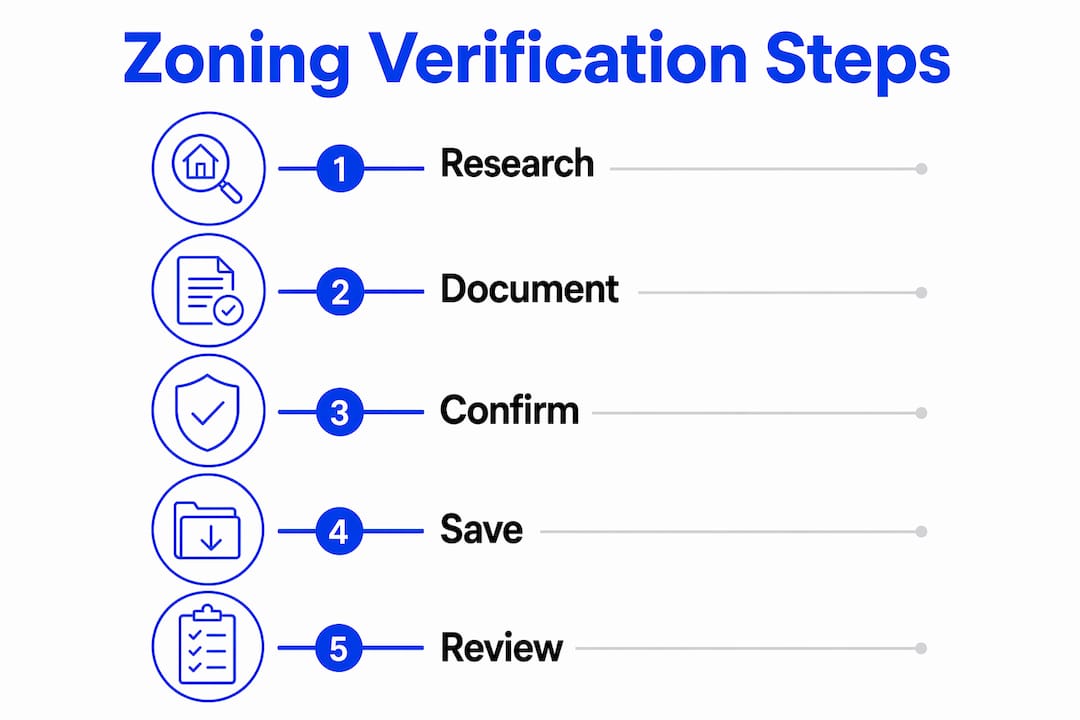
Pro Tip: Screenshot and save your GIS search results with a date stamp. Zoning maps are updated periodically, and having a dated record protects you if a dispute arises later.
What zoning challenges and restrictions landlords should know
Zoning compliance for landlords goes well beyond knowing the zone label. The restrictions that actually affect your operations and ROI tend to be buried in the details.
Short-term rental restrictions. Cities like Nashville, Los Angeles, and New York have layered STR regulations on top of base zoning. Owner-occupied and non-owner-occupied short-term rental permits carry distinct eligibility requirements. Non-owner-occupied STR permits are far harder to obtain and are banned outright in many zones.
Density, parking, and setback limits. Zoning defines the legal use, density, setbacks, and parking for every parcel. A property zoned for four units may only physically accommodate two if the setback and parking requirements consume too much of the lot.
Variance and rezoning timelines. Variance and rezoning applications take between 3 and 12 months and carry no guarantee of approval. This timeline directly impacts your acquisition strategy. Buying a property contingent on a rezoning approval is a high-risk position that most lenders will not finance.
Permit transferability. STR permits often do not transfer when property ownership changes. If you acquire a property with an active STR permit, that permit may be voided at closing, forcing you to reapply under current rules that may be significantly stricter.
Financing complications. Lenders closely review zoning compatibility for rental projects, and misalignment between intended use and zoning can delay or block loan approval entirely. A property you plan to operate as a multi-family rental must be zoned for that use before most conventional and portfolio lenders will underwrite it.
Zoning is not just a regulatory checkbox. It is a financial constraint that determines whether your intended use is legal, whether your lender will fund the deal, and whether your permits survive a change in ownership.
How does zoning affect the financial and operational side of rental investing?
Zoning shapes your rental income ceiling, your compliance costs, and your exit value. Investors who treat it as a back-office concern rather than a front-end underwriting variable consistently leave money on the table or walk into costly surprises.
The income side is straightforward: higher-density zoning allows more units per parcel, which multiplies gross rental income without multiplying land costs. A parcel zoned MF-3 in a strong rental market can generate three to five times the cash flow of an adjacent R-1 parcel of the same size. A property’s highest and best use is bound by its zoning classification, and properties with multi-family or mixed-use zoning regularly command premium sale prices because buyers are paying for that income potential.
The cost side is less obvious but equally important:
Permit and inspection fees tied to zoning compliance add to your operating expenses. STR permits in cities like Nashville carry annual renewal fees and inspection requirements.
Tax assessments can shift when a property’s use changes. Converting a single-family home to a multi-unit rental may trigger a reassessment at a higher commercial rate in some jurisdictions.
Compliance failures carry fines, forced vacancy orders, and in severe cases, permit revocation. Operating a rental outside its permitted zoning use is not a gray area. It is an illegal use that exposes you to municipal enforcement action.
On the marketing side, zoning classification directly affects how you position a property to tenants and future buyers. A mixed-use zoning designation is a selling point for commercial tenants and live-work buyers. Advertising a property’s zoning potential in your listing attracts buyers who understand value, not just square footage.
Pro Tip: When underwriting a deal, model two scenarios: one based on current permitted use and one based on the highest permitted use under existing zoning. The gap between those two numbers tells you how much upside is already legally available without a rezoning fight.
What steps should landlords take to handle zoning issues?
Zoning due diligence belongs in your acquisition checklist, not your post-closing to-do list. Here is a practical sequence for managing zoning from deal evaluation through ongoing compliance.
Confirm zoning before making an offer. Pull the GIS map, read the permitted use table, and verify that your intended rental strategy is a permitted use, not a conditional or prohibited one.
Engage a land-use attorney for complex deals. Mixed-use conversions, STR permit applications, and variance requests all benefit from legal counsel. Attorney fees at this stage are far cheaper than a denied permit or a failed closing.
Document everything. Keep dated copies of zoning confirmations, permit applications, approval letters, and inspection reports. If zoning rules change, your documentation establishes your legal nonconforming use status.
Apply for variances early. If your investment thesis depends on a use that requires a variance, start the application process before closing if possible. Given that variance applications can take up to 12 months, waiting until after acquisition puts your capital at risk.
Monitor municipal zoning updates. Cities revise zoning ordinances regularly, particularly around STR regulations. Subscribe to your local planning department’s newsletter or attend city council meetings where zoning amendments are discussed.
For investors building a portfolio, consider reviewing the zoning mistakes every investor makes before your next acquisition. The patterns are consistent and avoidable with the right preparation.
Key takeaways
Zoning compliance is a financial underwriting variable, not an administrative formality, and every rental property decision should start with a confirmed, parcel-specific zoning analysis.
Point | Details |
Zoning defines legal use | Residential, commercial, and mixed-use zones each carry distinct rules for rental type and density. |
GIS portals are your first tool | Use parcel-specific GIS searches to confirm base zoning, overlays, and permitted rental uses before any offer. |
STR permits are not transferable | Ownership changes can void existing short-term rental permits, forcing reapplication under stricter current rules. |
Variances take 3 to 12 months | Never build an investment thesis around a rezoning approval you do not yet have. |
Zoning drives financing decisions | Lenders underwrite rental projects based on zoning compliance, and misalignment can block loan approval entirely. |
Why zoning deserves the same attention as your cap rate
Most investors I work with spend hours modeling cap rates and cash-on-cash returns before they spend 20 minutes confirming what a property is actually zoned for. That is backwards. Zoning is the legal foundation that either validates or invalidates every number in your pro forma.
The misconception I see most often is that zoning is a problem you solve after closing. Investors assume they can operate first and sort out permits later. That approach works until it does not, and when it fails, it fails expensively. A forced vacancy order on a non-compliant STR can wipe out six months of projected income overnight.
The other pattern worth flagging: investors who buy adjacent properties and assume identical zoning. I have seen deals fall apart because a buyer assumed a neighbor’s STR permit confirmed their own property’s eligibility. Zoning is parcel-specific, and the line between a permitted and prohibited use can run down the middle of a city block. You can explore the key zoning factors every investor should evaluate before purchase to build a more disciplined pre-acquisition process.
Zoning is also not static. Cities are actively revising STR regulations, density allowances, and mixed-use overlays in response to housing demand and political pressure. The zoning that made a deal work in 2022 may have changed by 2026. Staying current is not optional. It is part of managing a compliant, profitable rental portfolio.
— Main
How 2ndstreetpropertymanagement helps you stay zoning-compliant
Zoning complexity does not have to slow down your portfolio growth. 2ndstreetpropertymanagement was built by investors who have navigated the same permit requirements, STR restrictions, and compliance challenges you are facing now. The team works directly with landlords and investors to confirm zoning eligibility, manage permit applications, and keep rental operations aligned with current municipal regulations. Whether you are evaluating your first acquisition or managing an existing portfolio, professional support reduces the risk of costly compliance failures. Visit 2ndstreetpropertymanagement.com to learn how the team can support your next investment decision with the zoning knowledge it requires.
FAQ
What is rental property zoning?
Rental property zoning is the local government system that classifies land into designated use categories such as residential, commercial, and mixed-use, determining what types of rentals are legally permitted on each parcel.
How do I find the zoning for a specific property?
Use your city or county GIS portal to search by property address and retrieve the parcel-specific zoning code, then cross-reference that code with the municipal zoning ordinance to confirm permitted rental uses.
Can I operate a short-term rental in a residential zone?
Many jurisdictions classify short-term rentals under 30 days as commercial lodging, which means standard residential zoning may prohibit STR operations without a separate permit or conditional use approval.
What happens if I buy a property with an existing STR permit?
STR permits are often non-transferable, so a change in ownership can void the existing permit and require you to reapply under current regulations, which may be stricter than those that applied to the previous owner.
How long does a zoning variance or rezoning take?
Variance and rezoning applications typically take between 3 and 12 months to process and carry no guarantee of approval, making pre-acquisition zoning confirmation critical for any investment strategy that depends on a specific permitted use.
Recommended
Comments