
Budget Rental Property Repairs: A Landlord's Guide

Every landlord eventually faces the same gut punch: a repair bill that wipes out two months of cash flow. Budget rental property repairs are not just a cost management exercise. They are a discipline that separates investors who build wealth from those who constantly react to financial fires. Whether you own one unit or twenty, the difference between a profitable rental and a money pit often comes down to how deliberately you plan, schedule, and track your maintenance spending. This guide gives you the frameworks, legal context, and real tactics to keep repair costs under control without cutting corners on quality.
Table of Contents
Key takeaways
Point | Details |
Use the 1% rule as a baseline | Budget roughly 1% of your property’s value annually for repairs and adjust for age and condition. |
Preventive maintenance cuts costs | Scheduled maintenance prevents emergency repairs that cost five to ten times more than routine service. |
Bundle repairs to save money | Coordinating multiple fixes in one vendor visit reduces mobilization fees and overall labor costs. |
Document every repair request | Tracking notices, responses, and completions protects you legally and supports dispute resolution. |
Keep 3 to 6 months in reserves | Liquid reserves equal to 3 to 6 months of rental income protect cash flow when surprises hit. |
Budget rental property repairs: the budgeting basics
Before you can control repair costs, you need a reliable number to plan around. The most widely used starting point is the 1% rule: set aside approximately 1% of your property’s value each year for maintenance and repairs. A $200,000 rental property, for example, would require roughly $2,000 annually. That number is not a guarantee. It is a floor.
Several variations build on this foundation:
The rental income rule: Budget 10 to 15% of your monthly gross rent for maintenance. A unit renting at $1,500 per month would generate a $150 to $225 monthly reserve.
The square footage rule: Set aside $1 per square foot per year. A 1,200 square foot unit would need $1,200 annually. This method works well when comparing properties of similar age.
Age and condition adjustments: Older properties with aging mechanical systems, original plumbing, or outdated electrical panels need a larger buffer. Add 0.5% to 1% on top of your baseline for properties built before 1980.
Method | Formula | Best used when |
1% rule | 1% of property value per year | General baseline for any property |
Rental income rule | 10-15% of monthly rent | Income-focused cash flow planning |
Square footage rule | $1 per sq ft per year | Comparing similar-age properties |
Age adjustment | Add 0.5-1% for older properties | Pre-1980 builds or deferred maintenance |
One distinction that matters for your tax strategy: routine repairs (fixing a leaky faucet, patching drywall) are deducted in the year they occur. Capital improvements (replacing the entire HVAC system, adding a deck) are depreciated over time. Mixing these up in your books will distort both your budget and your tax return.
Pro Tip: Track routine repairs and capital improvements in separate budget line items from day one. This makes tax filing cleaner and helps you spot when a recurring repair is really a capital replacement in disguise.
Building a preventive maintenance schedule
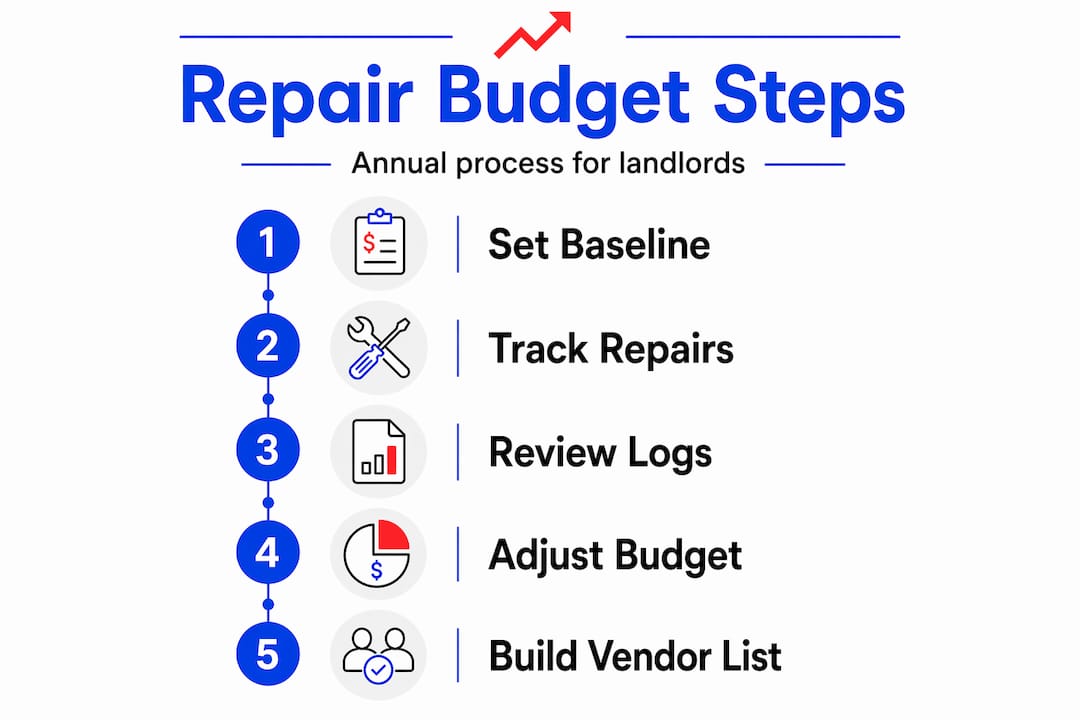
Reactive maintenance is expensive. Preventive maintenance reduces emergency repairs by addressing wear before it becomes failure. The math is not subtle. An HVAC service call runs $100 to $200. An emergency HVAC replacement costs $4,000 to $8,000. That single example justifies an entire year of scheduled inspections.
Here is a practical recurring maintenance calendar to build from:
Monthly: Test smoke and carbon monoxide detectors. Check for visible water leaks under sinks and around toilets. Confirm HVAC filters are clean.
Quarterly: Inspect roof and gutters for debris or damage. Check exterior caulking around windows and doors. Test GFCI outlets in kitchens and bathrooms.
Semi-annually: Service the HVAC system professionally. Flush the water heater to remove sediment. Inspect plumbing shut-off valves for corrosion.
Annually: Full interior walkthrough with tenant present. Check attic insulation and ventilation. Inspect electrical panel for signs of overheating or outdated breakers.
At every tenant turnover: Deep clean, full safety check, document all condition changes with photos and written notes.
The key to making this work is consistency. Preventive maintenance programs succeed because they are followed without exception, not because the tasks themselves are complicated. Use a simple spreadsheet or a property management app to log each task, the date completed, and the vendor or person who did the work.
Tenants notice when a landlord maintains a property well. That perception directly affects lease renewal rates, which is one of the most underrated cost-saving factors in rental property management. Filling a vacancy typically costs one to two months of lost rent plus turnover expenses. Keeping a good tenant through attentive maintenance is almost always cheaper.
Pro Tip: Send tenants a brief seasonal maintenance reminder each quarter. Ask them to report anything unusual. Tenants who feel heard report problems earlier, and early reports are almost always cheaper to fix.
Cost-effective strategies for managing repairs
Knowing what to spend is only half the equation. How you spend it determines whether you stay on budget or blow past it every year. These are the tactics that actually move the needle on affordable rental property repairs.
Bundle related repairs. Coordinating multiple repairs into a single vendor visit eliminates redundant service call fees. If a plumber is already on site fixing a faucet, address the slow drain in the same bathroom at the same time. This approach consistently reduces total repair costs compared to scheduling separate visits.
Get at least three quotes for any job over $500. Vendor pricing varies more than most landlords expect. A $900 quote and a $1,600 quote for the same repair are not unusual. Build a vetted list of two or three reliable contractors in each trade so you are not scrambling when something breaks.
Know when to DIY and when to call a pro. Cosmetic fixes like painting, caulking, replacing outlet covers, and patching small drywall holes are reasonable DIY rental property fixes for landlords who are handy. Anything involving electrical panels, gas lines, structural elements, or permitted work should go to a licensed professional. The liability exposure from a botched DIY repair on a rental property far exceeds the cost savings.
Use move-in and move-out inspections strategically. Detailed move-in documentation with photos and written condition reports gives you a defensible baseline. When a tenant moves out, you can distinguish normal wear and tear from actual damage and charge accordingly.
Plan for turnover costs. Budget $500 to $1,500 per turnover for cleaning, minor repairs, and touch-up painting. Landlords who treat this as a surprise expense every time are not managing their properties. They are reacting to them.
The hidden costs of rental property rarely come from one catastrophic event. They accumulate from dozens of small, unplanned expenses that a disciplined budget would have absorbed without stress.
Pro Tip: Build a preferred vendor list before you need it. Negotiating rates when you are calm and not in crisis mode gives you far more leverage than calling whoever answers the phone at 10 p.m. on a Friday.

Landlord repair responsibilities and tenant rights
Understanding your legal obligations is not optional. It is part of budget planning, because legal disputes are among the most expensive outcomes a landlord can face. In Texas, the law is specific about what landlords must repair and what happens when they do not.
Under Texas Property Code Chapter 92, landlords must repair conditions that materially affect health and safety. This includes issues like broken heating systems, water leaks that cause mold, and non-functioning smoke detectors. Tenants must submit a written repair request, and landlords generally have a reasonable time to respond, typically interpreted as seven days for most repairs.
If a landlord fails to act, Texas tenants have legal remedies:
Repair and deduct: Tenants can hire a contractor and deduct the cost from rent, capped at one month’s rent or $500, whichever is greater.
Lease termination: For serious health and safety failures, tenants may terminate the lease.
Court action: Tenants can sue for damages, rent reduction, and attorney fees.
“Repair and deduct legal remedies in Texas require strict procedural compliance. Landlords benefit from prompt, documented responses to avoid disputes.” — Texas State Law Library
Documenting every repair request is your primary protection. Log the date the request was received, your response, the scheduled repair date, the vendor who completed the work, and a photo of the finished repair. This paper trail demonstrates reasonableness and protects you if a tenant claims you failed to act.
Prompt response also prevents small repairs from becoming large ones. A tenant who reports a slow leak and waits three weeks for a response is not just a legal risk. The water damage accumulating behind that wall is a financial one.
Tracking and adjusting your repair budget over time
A budget you set once and never revisit is not a budget. It is a guess. The landlords who consistently manage cost-effective maintenance tips are the ones who treat their repair data as a feedback system.
Tracking category | What to monitor | Red flag signal |
Repairs per property | Total annual spend by unit | One unit consuming 40%+ of total budget |
Repair type frequency | HVAC, plumbing, electrical, cosmetic | Same system failing repeatedly |
Vendor cost comparison | Price per job by contractor | Consistent outliers above market rate |
Emergency vs. planned ratio | % of spend that was unplanned | Emergency ratio above 30% |
Reserve fund balance | Months of rent held in liquid reserves | Balance below 3 months of rent |
Maintaining 3 to 6 months of rental income in liquid reserves is the standard recommendation for landlords. A property generating $2,000 per month should carry $6,000 to $12,000 in accessible funds. This is not money sitting idle. It is insurance against the kind of surprise that turns a profitable year into a loss.
When the same repair category appears repeatedly in your logs, that is a signal to evaluate repair versus replace. A water heater that needs service three times in two years is not a maintenance item anymore. It is a capital replacement waiting to happen. Deferred maintenance from underbudgeting small repairs consistently leads to expensive emergency work and reduced property value. Catching that pattern early is the difference between a $400 repair and a $4,000 one.
Property management software or even a well-organized spreadsheet can surface these patterns if you log consistently. The tool matters less than the habit.
My perspective on repair budgeting
I have seen landlords with beautifully organized spreadsheets who still get blindsided by repair costs every year. The spreadsheet was not the problem. The discipline was.
What changed my own cost curve was not a better formula. It was committing to the preventive schedule and actually following it, even when nothing seemed wrong. The months where I did not find anything during a quarterly walkthrough were not wasted time. They were confirmation that the system was working.
The other shift was documentation. I used to treat repair records as paperwork. Now I treat them as an asset. Every logged request, response, and completed work order is proof of reasonableness if a dispute ever arises. It also tells me which properties are trending toward higher costs before they become a cash flow problem.
If you take one thing from this guide, let it be this: budget-friendly home repairs are not about spending less. They are about spending smarter. That means planning ahead, tracking what you spend, and building systems that catch problems when they are still cheap to fix. The landlords who do this consistently do not just save money. They sleep better.
— Main
How 2ndstreetpropertymanagement can help
Managing repair budgets across multiple properties takes time, systems, and experience that most landlords are still building. 2ndstreetpropertymanagement was built by investors who understand what it costs to run a rental property the right way.
From preventive maintenance coordination to vendor management and repair tracking, 2ndstreetpropertymanagement handles the operational details that protect your cash flow and your property value. If you want expert oversight on rental property management without the guesswork, the team at 2ndstreetpropertymanagement is ready to help. Visit 2ndstreetpropertymanagement.com to learn how professional management can turn your repair budget from a source of stress into a predictable line item.
FAQ
What is the 1% rule for rental property repairs?
The 1% rule means setting aside 1% of your property’s value each year for maintenance. A $200,000 property would need roughly $2,000 annually as a starting budget.
How much cash reserve should a landlord keep for repairs?
Landlords should maintain 3 to 6 months of rental income in liquid reserves. This covers unexpected repairs and vacancies without disrupting cash flow.
When can a Texas tenant use repair and deduct?
In Texas, tenants can repair and deduct costs from rent when a landlord fails to fix a health or safety condition after written notice. The deduction is capped at one month’s rent or $500 under Texas Property Code Chapter 92.
What repairs can landlords do themselves to save money?
Cosmetic DIY rental property fixes like painting, caulking, replacing hardware, and patching small drywall holes are generally safe for landlords to handle. Electrical, gas, structural, and permitted work should always go to a licensed contractor.
How do you reduce emergency repair costs on rental properties?
Preventive maintenance is the most direct way to cut emergency repair costs. Scheduled HVAC servicing, seasonal inspections, and routine safety checks catch problems early when they are still inexpensive to fix.
Recommended
Comments